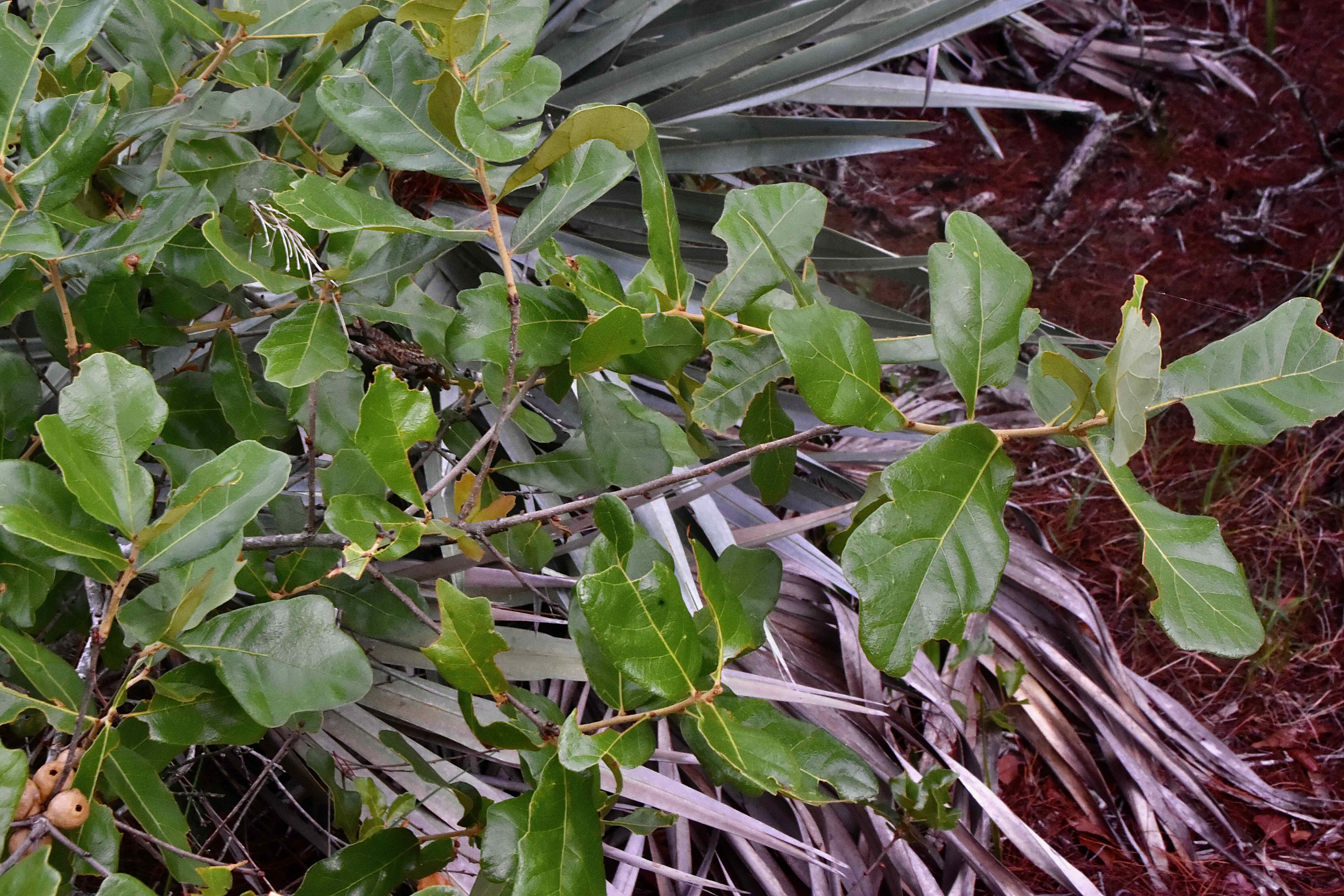
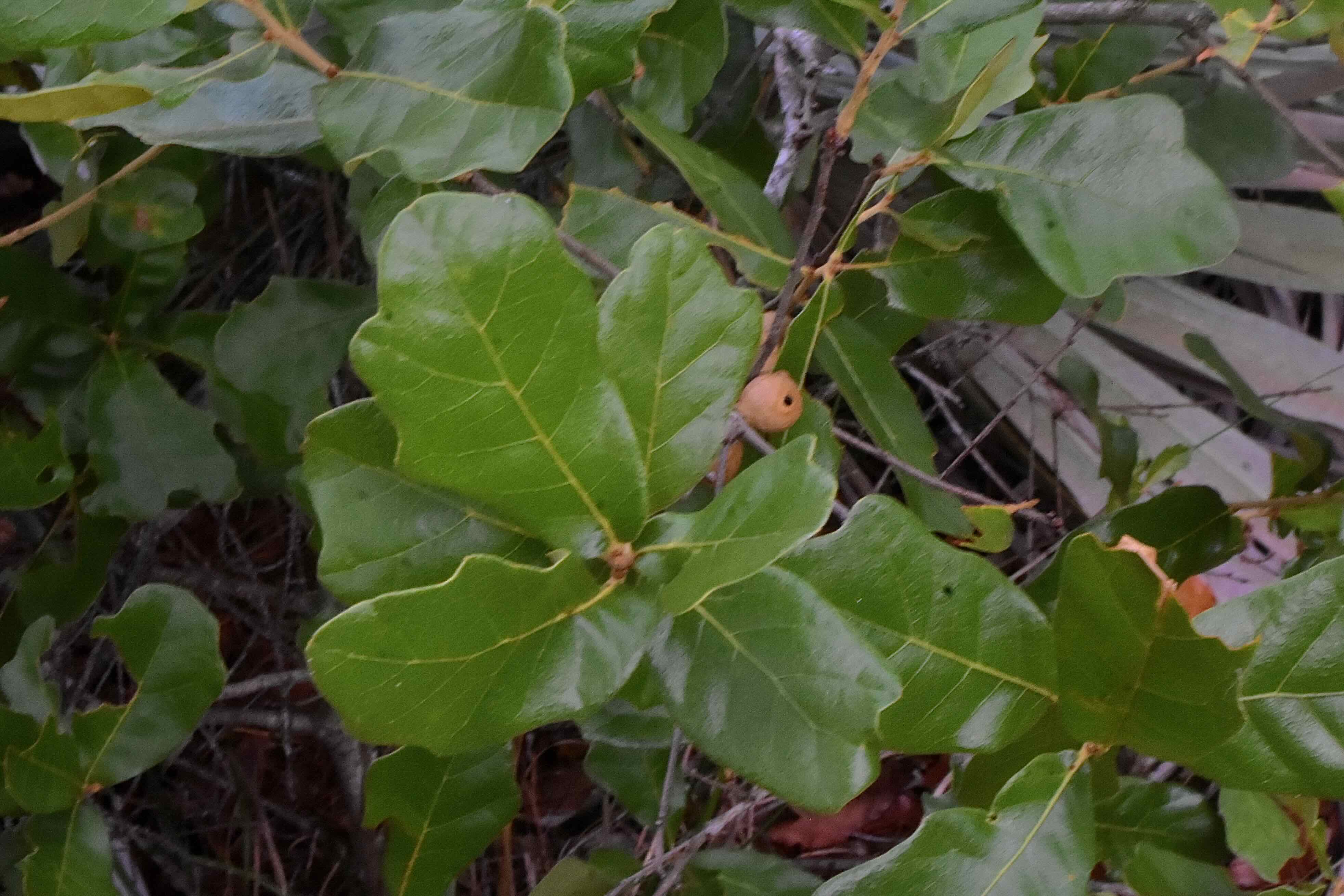
Chapman's oak, photographed at Blazing Star Environmental Preserve, Boca Raton, Palm Beach County, in April 2021.
Chapman’s oak, Quercus chapmanii, is one of a handful of shrubby oaks found growing in the drier habitats of South Florida. These are the so-called scrub oaks.
Like its cousins, it’s capable of growing to a respectable height under the right conditions — Chapman’s can hit 30, 35 even 40 feet — but usually settles far short of that because the places where it grows tend to lack both moisture and nutrients. That includes scrubs, open pinelands and xeric, or dry, hammocks.
It is a Florida native found in most Peninsular counties and scattered throughout the state’s northern tier. It is absent from both Hendry and Monroe counties.
It’s also found in South Carolina, Georgia and Alabama.
So who is Mr. Chapman and what’s his connection to this particular tree? He’s 19th century botanist and physcian Alvan Wentworth Chapman, who spent a good portion of his career exploring the wilds of northern Florida and Georgia. He’s among Florida’s most important naturalists, and the namesake Chapman Botanical Garden sits in Apalachicola. We’ll get to back to him in a bit.
First a bit about “Chapman’s” tree.
Scrub oaks are tough, adaptable trees that can take the hot and dry conditions of Florida’s sandy ridges and dunes. They grow slowly and tend to form dense, shrubby patches by sending out clones of themselves through rhizomes, or underground stems. Chapman’s oak is a fire-dependent species to a degree; low-intensity fires provide space for seedlings to germinate and grow, while the rhizomes will provide new shoots if the blaze top-kills the parent tree.

The leaves are glossy green above, dull green or even yellowish green underneath. They’re typically 1.5 to 3 inches long and 0.75 to 1.5 inches wide. Chapman’s leaves tend to be oblong, sometimes narrower at the base, sometimes with a pointed end. They can be slightly cupped downward, what botanists call revolute.
What helps distinguish Chapman’s oak from other scrub oaks is that their leaves generally bear three lobes. They’re not as deep or as distinct as the lobes you might see on an oak tree in northern environs. They might not be distinct at all in some cases. But their southern cousins, the Virginia live, sand live, myrtle and Florida scrub oaks aren’t lobed at all; dwarf oaks can be lobed but with a sharp apex, or point, on each.
Chapman’s oaks are what botanists call tardily deciduous, dropping their leaves not in the fall but in late winter or early fall. As the old leaves fall, new leaves are produced.
One bonus: the leaves of Chapman’s oaks can turn various shades of yellows, reds and oranges come of the cooler months of late fall and winter.
Chapman’s oaks bloom in late winter into spring, putting out stringy flower “spikes” called catkins. Both male and female flowers are produced on the same tree and both are an inconspicuous green. Chapman oaks are wind-pollinated typical of oaks, and yes, a pain in the nostrils, so to speak, for anyone with allergies. The flowers in turn produce acorns that usually hang in pairs on a stem called a peduncle. The acorns will mature later in the same year.
Chapman’s oaks take to places with full sun, and can thrive in a variety of soils, including those considered nutrient poor. It is drought tolerant as might be expected.
It’s a host plant for a variety of butterflies including Horace’s duskywing; its fruit — acorns — is food for a variety of birds and mammals, including the endangered Florida scrub jay and the extremely common eastern gray squirrel, both of which play key roles in dispersing the seeds. Deer will browse on the leaves and branches. We humans use Chapman’s as a landscaping element.
As we noted above, Alvan Chapman is an important figure in Florida’s natural history, and there are a fair number of Florida native species that bear his name and honor his work. He was the first naturalist to distinguish Chapman’s oak in his Flora of the Southern United States published in 1897.
In 1860, Chapman called the oak Quercus obtusiloba var. parvifolia (a variety of the post oak now known scientifically as Q stellata) based on specimens from Florida. One Charles Sprague Sargent, a botanist and director of Harvard University’s Arnold Arboretum, picked up Chapman’s work, reclassified the tree as a species in and of itself and gave it the Chapman name.
Chapman’s oak is also known as Chapman oak, Chapman white oak and scrub oak. It is a member of Fagaceae, the family of beech and oak trees.
Blazing Star Environmental Preserve
Photo Gallery — Click on photo for larger image